| Problems viewing this? Click to view in your browser |

Afternoon Edition |

|
|
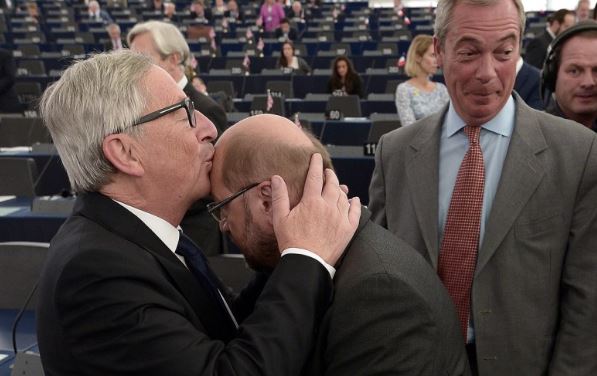
“We are not in a good place. There is a lack of Europe in the EU and there is a lack of union in the European Union. That has to change.” Those are the frank words of Jean-Claude Juncker. In a 90 minute “state of the union” speech to MEPs, the European Commission president warned that Europe’s migration crisis threatened to unravel the EU as countries squabbled over who should take refugees. He said Britain will be asked to become part of a permanent system of European Union migrant quotas to replace existing asylum rules under proposals for a Europe-wide immigration system. The proposals will be a challenge for David Cameron, the prime minister, as he negotiates a new relationship between Britain and Europe, as an EU legal migration system would have major implications for Britain under European free movement rules. Mr Juncker said he was “totally convinced we will have a fair deal for Britain”. Mr Juncker also jousted with Nigel Farage, the leader of Ukip, who regularly heckled him from a few feet away in the European parliament’s Strasbourg chamber. “The only quality we share is humour,” he said. Bruno Waterfield, our Brussels correspondent, has all the details here. Meanwhile, back in the UK, there’s further evidence of a two-speed recovery. Britain’s factories suffered a sharp setback in July as exports fell sharply in a move that is likely to dampen the recovery, official figures show. Manufacturing output contracted by 0.8 per cent between June and July, falling well short of forecasts for 0.2 per cent growth, and by 0.5 per cent compared with last year, according to the Office for National Statistics. It was the industry’s first annual decline since August 2013. Separate data from the ONS showed that Britain’s trade deficit widened by £2.6 billion in July to £3.4 billion, with the poor manufacturing performance accounting for the entire increase. The trade surplus in services held steady in a sign that the UK’s most dominant sector, which accounts for three quarters of national output, is still powering ahead. Philip Aldrick, our Economics Editor, has the full story here. As economists warned that the figures suggested GDP growth may slow from 0.7 per cent in the second quarter to 0.6 per cent in the three months to September, easing pressure on the Bank of England to raise interest rates, traders sold the pound. Sterling slipped 0.16 per cent against the dollar to $1.5370 but recovered early losses to trade up against the euro. You can follow all the news and reaction on the Business Now live blog. Finally, Monitise, the British mobile payments business, has once again failed to live up to its name after reporting a staggering £223.6 million loss for 2015 and the departure of its high profile American chief executive only six months after she took charge. Elizabeth Buse, a former top executive at Visa, joined the British business last year to work alongside its founder Alastair Lukies. She became sole chief executive in March after an attempt to sell the business failed to attract an attractive bid but has abruptly departed the company for “personal reasons”. That shock, combined with a fresh warning that the business will not grow next year, wiped a third off the value of the Monitise share price. The shares traded at 3.88p this morning which means that the business joins the infamous “90 per cent club” with the stock having lost 92 per cent of its value over the past year. Nic Fildes, our Technology & Communications Editor, has the full story here. Have a great day. Rebecca Clancy |

|
|
|
The FTSE 100 is rallying for a third day, up 130.96 points to 6,277.06, driven by strong gains on Wall Street last night and Asian markets, particularly Tokyo. Commodity prices are firmer, supported by China’s finance ministry vowing to support the struggling economy. Those companies selling such products are among the biggest risers in London. Anglo American is up 40¾p to 744½p. Finance stocks are also gaining in rebounding stock markets. Decent full-year numbers from Hargreaves Lansdown and an upgrade from Nomura has also boosted the financial services company, 69p higher to £11.84. In broad-based gains only a few stocks are again under water on the blue-chip index. Weir Group, soon to be demoted to the FTSE 250, is down another 13p to £12.67 on a downgrade from Canaccord Genuity which expects flat earnings in 2016. |

|
|
|
|
| Jean-Claude Juncker, President of the European Commission, kisses the head of the European Parliament, Martin Schulz, with UKIP MEP Nigel Farage smirking just behind. Mr Juncker told Mr Farage that "the only quality we share is a sense of humour" . | |

|
|
|
It’s Apple day today, although you can hardly have failed to notice. The company is expected to announce new iPhones, an Apple TV box and possibly new iPads at an event at the Bill Graham Civic Auditorium in San Francisco. On the economics front, The US Labor Department will release job openings and labor turnover data. Job openings, a measure of labour demand, are likely to have risen to 5.288 million in July from 5.249 million in the prior month. On the earnings front, bookstore chain Barnes & Noble is expected to report a first-quarter profit above the average analyst estimate. Barnes & Noble is improving store merchandise, featuring popular books and movies, and integrating its online and retail platforms to reverse falling sales. Some of the company's efforts, such as overhauling its toys and gifts division, have been paying off, according to Reuters. Barnes & Noble spun off its profitable college books business last month to focus on its retail bookstores and it hired a new CEO for the bookstore arm. It is expected to report earnings of $1.05 per share on revenue of $1.4 billion, compared with a net loss of 56 cents per share on revenue of $1.2 billion for the same period last year. Cloud storage provider Box, whose rivals include privately held Dropbox, Microsoft's OneDrive, Citrix Systems' ShareFile and Google's Drive, will report its second-quarter results after the markets close. Last quarter, the company raised its full-year revenue forecast as more customers signed up for its content-sharing platform. Analysts project revenue of $69.8 million and a loss of 29 cents a share. Last quarter, Box reported revenue of $65.6 million, beating forecasts. Alexandra Frean |

|
| "We won't be swayed by short term economic fluctuations in our big picture direction." |
| Chinese Premier Li Keqiang insists the prospects for China's economy are positive despite relentless indications of a slowdown. |

|
|||||||||||||||
|
|||||||||||||||
|
|||||||||||||||

|
|||||||||||||||||||||||||||||||
|
|||||||||||||||||||||||||||||||
| Unsubscribe | Update Profile |
|
This email was sent by: %%Member_Busname%% %%Member_Addr%% %%Member_City%%, %%Member_State%%, %%Member_PostalCode%%, %%Member_Country%% |